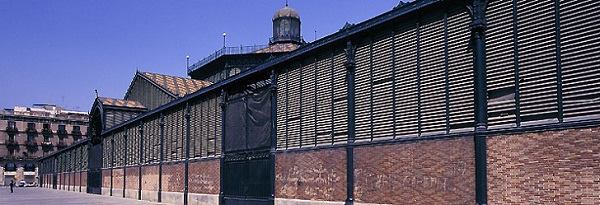
You know it but you don’t often see it—the modern city floats above its history. I mean that literally: As we build up and leave the past behind, we accrete layer after layer of human geology, creating a crust that can reach astonishing depths. That tiered reality hit me last week when I visited the Born market during my visit to Barcelona.
Once the city’s main fruit and produce wholesale market, it is now empty, its lacy iron, brick, and glass structure restored to show off all its delicacy. There is, however, no floor in what was the main hall: instead you look down a full 12 feet at the remains of the old medieval city that was razed by French occupiers during the 18th century. You can remain in the here and now, in a grid repeated in the solid blocks of apartment buildings around the market you can see through the plate glass, or you can descend into the complexity of what remains of the medieval city, twisting its way around an ancient waterway, and look back up at the present.
That dislocation is the most powerful message that a museum commemorating Barcelona’s loss of independence has to offer. (Though, truth be told, I visited before the displays were completed in the side aisles; the museum opens this fall.) The story is this: In 1714, French troops, supporting their Bourbon candidate as King of Spain, besieged Barcelona, as Catalonia had allied itself with the rival Habsburg contender. On Sept. 11, the city surrendered, and the French cemented their control over all of Spain, incorporating what became just a province into the centralized state. The victors razed 20 percent of Barcelona and built their garrison in this area. Later, a park, the parliament, and housing blocks rose around the market, completed in 1878 to a design by Josep Fontserè i Mestre.More than a century later, in 2000, the city government decided to turn the now abandoned building into a market. But excavations revealed the remains of the old city, and the library went elsewhere. When the current nationalist government replaced the former socialist, one, they decided to make Born into a kind of shrine to the State of Catalonia.
The interventions are minimal, consisting mainly of signs, handrails, lighting, and stairs that let you access the archaeological site. While I was there, Barcelona city architect Vicente Guallart was grumbling about the appearance of an electronic sign, even texting various authorities to see if he could get it removed. The point is to concentrate on what was lost, both physically and politically, not on what is the status quo.
In that sense, Born is one of the purest monuments that I have seen in a long time. It does not pretend to be much of anything else, concentrating instead on the recovery of the past. The contrast between the sweep of empty space, barely contained by the light structure that itself recalls the industrialization that led Barcelona back to prosperity—together with the denseness of the old city, which rises to its full height just a few blocks to the west in the city’s historic core—is made legible because it is so immediate. It reminded me of Adolf Loos’s statement that the only true architecture was a gravestone in the middle of a forest. This marker might sit in the middle of urban life, but it is as redolent of architecture as a memorial fact as anything I have seen in recent years.